Toggle Side Panel
The Working Artist Learning Site
  • TWA Site
  • Support
  • LOG IN
More options

    Shopping Cart

    No products in the cart.

    Sign in
    • TWA Site
    • Support
    • LOG IN

    Bedtime Stories for Artists

    True stories about walking the creative path — with faith, failure, money, and meaning.

    This isn’t a training. It’s not a webinar. It’s a story.

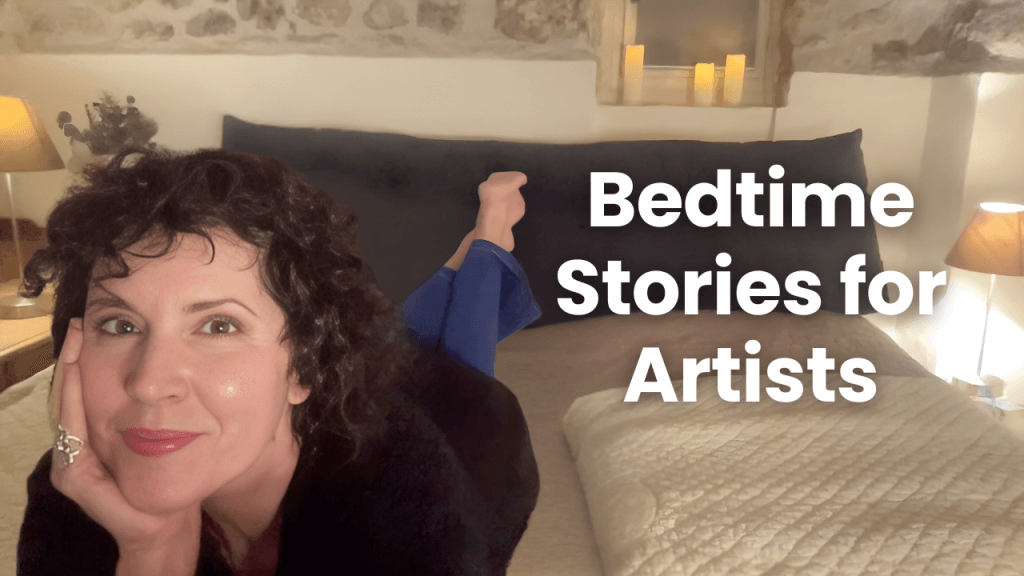
    I filmed this lying on my bed  — because I wanted it to feel soft. Gentle. Honest. Like a late-night conversation between artists.

    The world feels heavy right now. This is a place to pause. To reflect. To remember you’re not alone.

    🟡 Watch the video below, or scroll down to read the full transcript.

    Transcript: 

    Hi. I’m Crista Cloutier from The Working Artist.

    I decided to film this from my bedroom — which is actually a stone cave — because this isn’t a presentation. It’s not a pitch. It’s a story.

    And I wanted to tell it from somewhere quiet. Somewhere soft. Because I think that’s what we’re all craving right now.

    A few weeks ago, I shared the 10 Steps to Working as an Artist, and the response surprised me.

    Artists wrote to say things like:

    “This is exactly what I needed.”

    “This finally makes sense.”

    And asked “Can we go deeper?”

    So that’s what I want to do today.

    But not as theory.

    Not as another training you watch and then forget.

    This is a conversation — one that I hope offers real value in a moment when so many of us feel overwhelmed.

    The world feels heavy right now. Most artists I speak with are anxious, uncertain, and distracted by what’s happening— not because they don’t care, but because they care deeply.

    That’s why we need spaces like this.

    To pause.

    To reflect.

    To remember what matters.

    And to remember that we’re not alone.

    We recently held the Welcome Salon inside The Working Artist Academy.

    And the one word I heard again and again was: community.

    In a time when so much feels fractured, that gathering reminded me of something simple but true: We are not meant to walk this path by ourselves.

    So today, I want to return to the heart of the 10 Steps to Working as an Artist.

    Not in a linear way — but in a deeper one. Not as a list. But as a spiral.

    Because these aren’t steps you check off.

    They’re places you return to — again and again.

    And each time you do, you see more.

    You understand more.

    You become more.

    And I want to start where most artists get stopped.


    STEP 1: CLAIMING YOU ARE AN ARTIST

    That first step sounds simple. It’s not. Because this is where so many artists — even talented, accomplished artists — get stuck.

    I worked with a professional artist not long ago. She was making good work, getting some attention… but she couldn’t break through to the next level.

    And when I asked her about being an artist, she said: “I don’t like that word. It sounds show-offy and big-headed. It’s not for me to say — it’s for other people to say.”

    And right there, I saw the ceiling that stopped her. She was waiting for permission.

    So now let me tell you about an artist who never waited for permission. A sculptor named Luis Jimenez.

    When Luis was just starting out, a local gallerist took a gamble and gave him space in a two-person exhibition. This was a big deal — a real gallery, a real opportunity. But even that big gallery couldn’t contain Luis. He didn’t want a two-person show. Luis wanted a one-man show. The gallerist refused.

    Well, the deadline for delivery of the artwork came and went. No work, no Luis. He didn’t answer his phone.

    The day of the show arrived. No work, no Luis.

    The gallerist was beside herself.

    Doors opened. Guests arrived. Everyone poured into the other artist’s gallery room and the party began.

    And that’s when Luis stormed in — a roll of butcher paper under his arm. He went into the empty room that was supposed to be his space.

    He tore off a sheet of butcher paper.

    He sat on the floor.

    And he drew.

    He signed the drawing and cast it aside.

    Someone snatched it up.

    Luis ripped away another sheet.

    Now everyone was interested in what this crazy artist was doing on the floor.

    They began streaming in, surrounding him.

    Then they started fighting for the work. He couldn’t draw fast enough.

    The gallerist — who had been panicking an hour earlier — was suddenly clutching fistfuls of checks and credit cards.

    The next day, all of Luis’s sculptures and prints arrived. Sight unseen, his show had already sold out. It was the start of an illustrious career.

    Now, I’m not telling you to behave like Luis. His wild spirit would eventually cost him professionally — he paid a price for being difficult. And I worked him for years and god bless him, he was a pain in the ass.

    But here’s what he understood: He wasn’t waiting for anyone to decide if he was artist enough. He wasn’t asking permission. He wasn’t apologizing.

    He claimed it.

    And the world responded.

    So here’s the question I want you to sit with — not as a self-improvement exercise, just as truth: Where are you still waiting?

    For a gallery to choose you?

    For an institution to validate you?

    For a sale to prove you?

    For your parents to finally get it?

    You don’t need to fix it today.

    Just notice it.

    Because waiting for validation is exhausting.

    And it keeps you small.


    STEP 2: SETTING YOUR COURSE

    Most artists think they need a five-year plan. You don’t.

    What you need is orientation.

    When I started art school, studying under Bill Jay, I knew what I wanted. I wanted to write, teach, and make photographs. Bill Jay told me that if I got my degree in the history of photography, I could do all three.

    But life seemed to have other plans.

    After graduation, I took an internship at an art studio. Within a year, I was running it as the director. I stopped writing. I stopped making my own photographs. Life got too busy.

    I told myself to consider it an apprenticeship. I was learning the art business. I was working with amazing artists. I was building something.

    And I was.

    But after ten years of making and selling other people’s art, I knew — I’d lost my way.

    Then on my birthday, a package arrived.

    Inside was a framed photograph and a note from an old friend that said:

    “This is work by an artist who shows great talent. I think it’s someone you should pay attention to.” The photograph was one that I’d taken years before.

    That friend was right but I didn’t know what to do about it or how to find my way back.

    A few days later, I was having coffee with another friend and he was complaining about his job when he said, “I wish I could just sell everything I own and move to the south of France.”

    And something inside me whispered: Follow this.

    I remembered a tiny village in France where I’d studied at an art school years before. It was the last place I’d felt truly creative. There had been an American artist living there — I wondered how he’d done it. I couldn’t remember his name.

    That afternoon, flipping through an art magazine, I turned the page and my heart stopped. Because there was an article about Dan Adel — the very artist I’d just been thinking about. The one from that village.

    The Universe was speaking.

    So I jumped, quit my job, sold everything I owned.

    I took a huge leap of faith. And I’m speaking to you today from my bedroom in that French village. And Dan Adel has become a dear friend.

    Here’s what I learned: Bill Jay was right all those years ago. Today I am a writer and a teacher and a photographer — all the things he promised me.

    But I’m doing it in ways I never could have imagined back then. These platforms didn’t even exist.

    And those years I spent “lost” in the art business? I wasn’t wasting time. I was gathering the knowledge and context that would make everything I do now possible.

    The path wasn’t straight. But it was coherent.

    And that’s the secret to setting your course: You don’t need to know the whole journey. Forget about what’s possible or not. You just need to know your orientation.

    What do you want most from your artist life?

    Not how. Just what. That’s your north star.

    And when you wander too far from it — and you will — life will whisper.

    A photograph. A conversation. A magazine article appearing at exactly the right moment.

    Pay attention to the whispers. Each time you hear “Follow this” Those whispers are not pulling you off your path. They’re showing you the way back.


    STEP 3: FEAR

    And this is where I want to talk about a topic that makes artists sweat.

    Money. Prices. Value.

    Pricing lives under fear in the 10 Steps for a reason. Because most artists think pricing is a math problem — like if they just had the right formula, everything would settle down.

    It’s not a math problem. It’s a psychological one.

    Let me tell you two stories. 

    When I worked at the art studio, we once invited a very well-known artist to work with us. You’d know her name — she’s in the history books.

    Her heyday had passed, her reputation as “difficult” got in her way, and though she had a strong market, it wasn’t what it once was.

    She created exquisite pieces in the studio. But when it came time to price them — she and I had conflict. I wanted to price what the market would pay. She wanted to price with her ego.

    At the end of the day, she got her way. And even though I had built up a lot of excitement about the work as she was making it, and I had willing buyers with cash in hand…

    They disappeared when they heard the price. The work didn’t sell.

    That’s overpricing.

    And it’s not confidence. It’s ego — and ego is just fear wearing better clothes.

    Now here’s the other side.

    An artist was selling at a fair. Or trying to. All around him, red dots were flying. But his work didn’t move. He was distraught.

    Until another artist looked upon him kindly, came into his booth… And added a zero to all of his prices. That’s when the work began to sell.

    You don’t just have to know your market. You have to know your room.

    And both patterns come from the same place: A fear of being seen accurately.

    Some artists underprice out of fear — softening the number before anyone even asks. They apologize instead of making the sale.

    And some artists overprice because they’re protecting themselves. Because if you say no… it’s not really about me.

    Pricing is not about proving your worth. It’s about offering your work into the world in a way that’s fair and sustainable. A clear price is an act of integrity.

    And here is the line I want you to remember, because it changes everything:

    When someone says no to a price, they are not saying no to you as a person or to your talent. They are making a decision based on their own circumstances.

    So the question that actually matters is this: What do you make a “no” mean?

    Because until that story shifts, pricing will always feel charged.


    STEP 4:

    Now we get to the part that grounds everything else.

    Craft.

    Craft is not about being perfect.

    It’s about relationship — with your materials, your process, yourself.

    I worked with the artist James Turrell for ten years. James works with land and light, and I personally believe he’s a genius, a modern-day Da Vinci.

    He told me he never intended to be an artist. He was a farm kid, lucky enough to go to college, where he studied psychology.

    In the 1960s and 70s, professors showed slides on projectors. But James said the images on screen didn’t interest him. He was fascinated by the beam of light coming from the projector. It captured all the dust in the air. He wondered what else it could do.

    So he started playing with it.

    Studying it.

    Learning the physics of it.

    And over time, he became a master of his craft — and one of the world’s greatest light artists. Even winning the MacArthur Genius award.

    That’s craft. Noticing what everyone else ignores. Wondering: What else can this do?

    And here’s what I see constantly: When artists feel lost or blocked, the answer is almost never “try harder.” It’s almost always: return to craft.

    Craft is where pleasure lives.

    Where time disappears.

    Where comparison quiets down.

    It asks one question: Are you paying attention?

    Because the more you try to make work for the market, the less alive it becomes.

    And the market responds to aliveness.

    Craft is how aliveness enters the work.


    STEP 5:

    Now something important happens. Voice.

    Voice is not something you invent.

    It’s not something you’re missing.

    Voice emerges from the work.

    Let me go back to James Turrell. His fascination with light didn’t really begin in those psychology classrooms. He’d been raised in the Quaker religion. Quakers believe light is a metaphor for God.

    James told me that every time he went to church, his grandmother would urge him to seek the light. She was talking about the light within.

    When James discovered he could make art with light, he realized: This was his message.

    His lightworks are spiritual in nature — not just scientific.

    Do you see what happened?

    The craft came first — the obsession with the beam, the mastery of physics.

    But the voice was already there, waiting. It came from his grandmother’s words.

    From something deeper than technique.

    Voice is what you bring to your craft.

    And here’s what I want to say: So many artists make honest work… and then freeze when asked about it. They say, “I want my art to speak for itself.” Or, “I don’t really know what it’s about.”

    I understand why you’d want to protect the mystery. But silence doesn’t create mystery.

    It creates distance.

    Voice helps people stay with the work. Not by explaining everything — but by offering enough truth that someone can recognize they’re in the presence of a real human being.

    Voice is alignment. It’s the feeling of: this person is being honest.


    I’m going to skip up to STEP 7  because we have to talk about the part that makes artists collapse inward. Failure

    Most artists don’t experience failure as information. They experience it as an identity verdict.

    A show doesn’t sell → my work isn’t good.

    An application is rejected → my work isn’t good.

    An email goes unanswered → my work isn’t good.

    And over time, that interpretation becomes heavy.

    Every artist I’ve mentioned today has experienced failure.

    And here’s the truth: The bigger the art career, the bigger the failures.

    Artist Vik Muniz — if you don’t know his work, look him up. There’s an Oscar-nominated documentary about him called Waste Land that you’re going to love.

    Vik never planned to be an artist. He was working in advertising in Brazil when he got shot during a party. Shot in the ass, to be specific.

    The settlement money from that shooting brought him to America, where he met a new group of friends and they introduced him to art.

    That literal failure — getting shot in the ass— redirected his entire life. Today he’s one of the world’s top exhibiting artists.

    And Vik told me something that changed how I think about success. He said: “I see success as the times I failed to fail.”

    Success is the times I failed to fail. I love that.

    Vik stands tall on his failures. He doesn’t have time for shame.

    And here’s what I want to say to you:

    None of us do. Shame and creativity are a lethal cocktail. Be very careful about wallowing in it.

    Failure in the art world is not a referendum on your worth. It’s feedback from a complex system.

    Here’s the reframe: Failure is data — not destiny.


    STEP 8: PERSISTENCE

    Persistence gets a bad reputation. People think it means grinding. Forcing. Pushing. That’s not what I mean.

    Persistence is about staying in relationship with your work — especially when the world goes quiet.

    Artists don’t stop because they run out of ideas.

    They stop because they lose meaning.

    They stop because they feel invisible.

    Or foolish.

    Or exhausted from trying.

    Let me tell you something Kiki Smith once told me. Now if you don’t know her, Kiki’s work is in the collections of MoMA, the Whitney, the Guggenheim. She’s had retrospectives at major museums around the world. Time Magazine listed her as one of the 100 most influential people.

    But there were times in her career when she had no money. Not even for art supplies.

    She raided dumpsters to find cardboard.

    And she told me something I’ve never forgotten: “Artists get stopped where they want to get stopped.”

    If you want to work as an artist, you can’t get stopped.

    Not by lack of money.

    Not by lack of recognition.

    Not by lack of encouragement.

    You find a way.

    And the question isn’t whether you’ll ever feel discouraged.

    You will.

    The question is what you do the day after.

    And then there’s the final step.

    Faith.

    Not religious faith.

    Not blind optimism.

    Faith as in: I will keep taking the next step even when I can’t see the whole staircase.

    Think about the stories we’ve talked about today.

    Luis — storming into that gallery with a roll of butcher paper, not knowing if anyone would buy a single drawing.

    Me — boarding a plane to France, not knowing how I’d put bread and cheese on the table.

    Kiki — raiding dumpsters for cardboard, not knowing if the work would ever be seen.

    James — staring at a beam of light in a classroom, not knowing it would become his life’s work.

    Vik — standing tall on his failures, because he understood they were part of the path.

    This is where artists tend to diverge.

    Some harden.

    They brace.

    They demand proof before they move.

    Others soften.

    They stay available to what’s still forming.

    Faith doesn’t mean certainty. It means remaining in relationship with your work even while it’s unfinished. Even while you’re unsure. Even while the outcome is still hidden.

    That’s what working artists do.

    We don’t wait for permission.

    We don’t wait for certainty.

    We don’t wait until we feel ready.

    We take the next step we can actually take.

    And here’s what I know after all these years:

    You can walk on faith alone. But it’s so much harder than it needs to be.

    And if something inside you is whispering “Follow this” — you’re not imagining it.

    That’s your compass. Your orientation. The artist in you trying to stay awake.

    I’ll tell you more in a moment about how I’ve built a space for artists to do exactly that — to stay awake, supported, and moving forward.

     But right now, I want to leave you with this:

    You’re not wrong. You’re not late. You’re not broken.

    You’re right on time. And your work matters.

     Now — these steps aren’t something you check off once.

    They’re questions you return to, again and again, as your work evolves.

    And after working with thousands of artists, here’s what I know:

    You can do this alone.

    But you don’t have to.

    The Working Artist Academy is where I guide artists through this journey, live.

    Learn more here

    The Working Artist Academy is a 12-week, live, guided container.

    It’s structure.

    It’s support.

    It’s real-time coaching.


    It’s practical tools that actually move your work forward — inside a space that understands how vulnerable this path can be.


    Everything is recorded. So if life happens — you don’t fall behind.

    And yes — we include AI training. But as an assistant, not a replacement.


    What artists tell me, over and over, isn’t: “Thanks, I needed more motivation.”

    It’s:

    “I finally know what to focus on.”

    “I can talk about my work without freezing.”

    “I understand pricing without shame.”

    “I’m selling my work like never before.”


    Because the hardest part of being an artist isn’t talent.

    It’s carrying it.

    Carrying your doubt.

    Your pricing.

    Your voice.

    Your persistence when you’re tired.

    The failures you’re still interpreting as proof.


    The Academy holds that.


    We recently held our Welcome Salon — and the moment really stayed with me.

    I want to show you something.

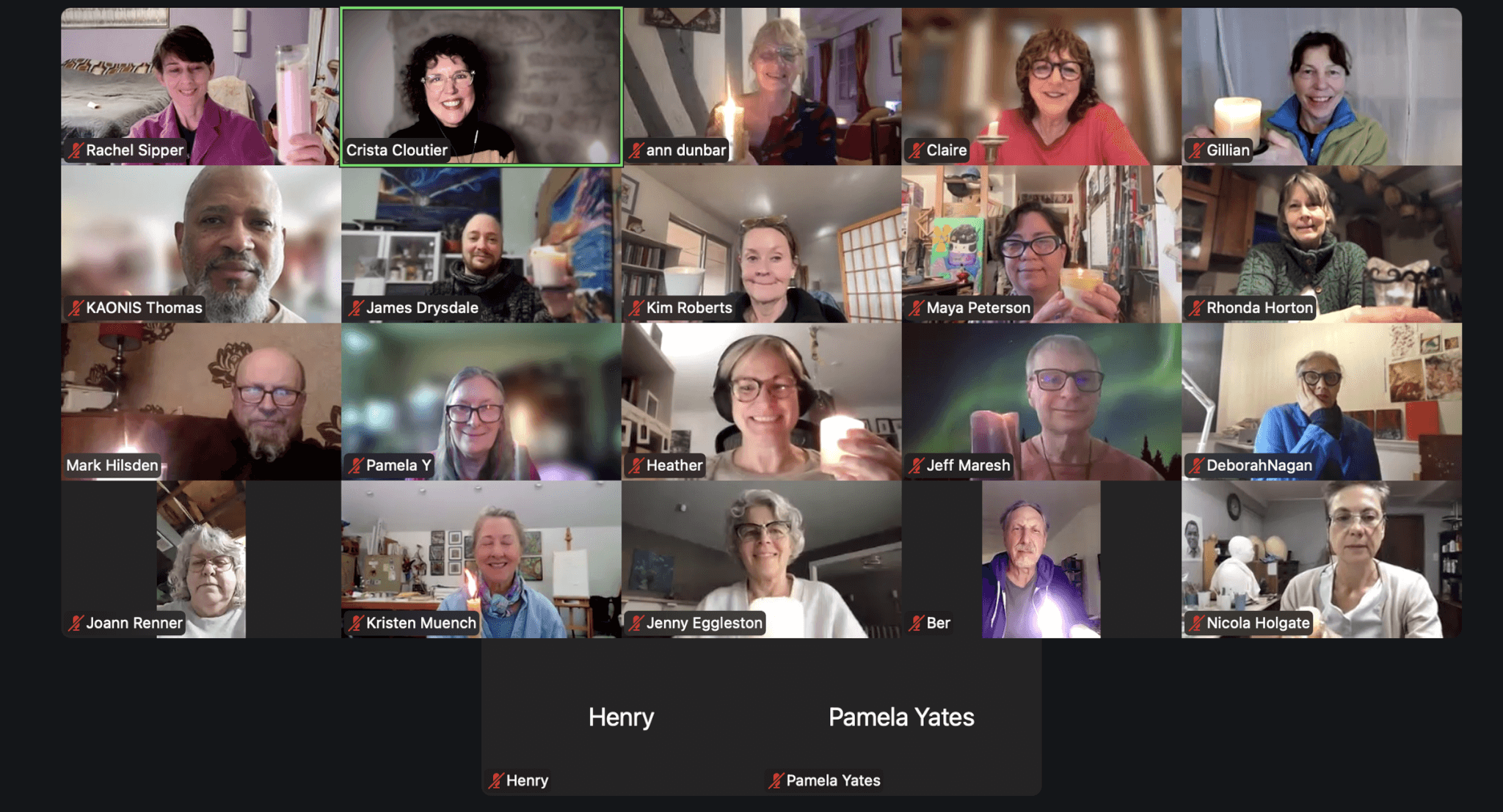
    Welcome Salon Group Photo

    This is the group that’s already inside.

    Real artists, from all over the world.

    Different backgrounds. Different voices.


    But they all came for the same reason:

    To stay close to their work.

    To not walk this path alone.

    If you feel something stir when you look at this — that’s not an accident.


    Yes, the Welcome Salon has already happened — and it was beautiful.

    But if you’re finding your way here now, it’s not too late.


    We built this to meet you where you are.

    Everything is recorded. Nothing moves without you.


    And the community is still gathering, still forming, still opening its arms.

    Doors will close in a few hours — because this is a live, held container. Not a mass download.


    But for now? There’s still time.


    If something inside you is whispering: Follow this — I urge you to listen.


    You don’t need another year circling the same questions.

    And you don’t need to carry it all by yourself.


    Luis claimed it.

    I jumped.

    Kiki kept working.

    Vik stood on his failures.

    James followed the light.


    These weren’t acts of solitary heroism.

    They were acts of faith — supported by teachers, mentors, and structure.


    The work is ready to move.

    This time, you don’t have to carry it alone.

    I’ll see you inside The Working Artist Academy.

    Join The Working Artist Academy
    Crista
    January 27, 2026
    « A Few Hours Before
    Crista! Are the doors closing? »

    See Your Art Career with Fresh Eyes

    Created by art mentor Crista Cloutier, this short self-assessment reveals the  
    strengths of your current practice and offers insight into the next step of your professional path.

    Personalized insight

    Practical next steps

    Encouragement to grow your art

    The Working Artist Learning Site

    Trusted by artists in 80+ countries


    Fellow, Royal Society of Arts


    Gold Medal, French Academy of Arts, Sciences, and Letters 

    Winner, Best Online Art Business Artist 2025 

    Guiding artists toward confidence, clarity, and creative freedom since 2014

    Contact 
    Privacy Policy
    Copyright The Working Artist 2025
    Learning and Web Design by Learnbase