

Your Goals
Video Index
Workbook
Take Notes Here if you Like!
Just type in whatever you might find handy and your notes will be saved.
1. Write Your Own Obituary
2. List 3 artists whose work you admire.
3. List 3 artists whose careers you wish to emulate.
4. Dan Rizzie CV
5. Claudia Bernardi
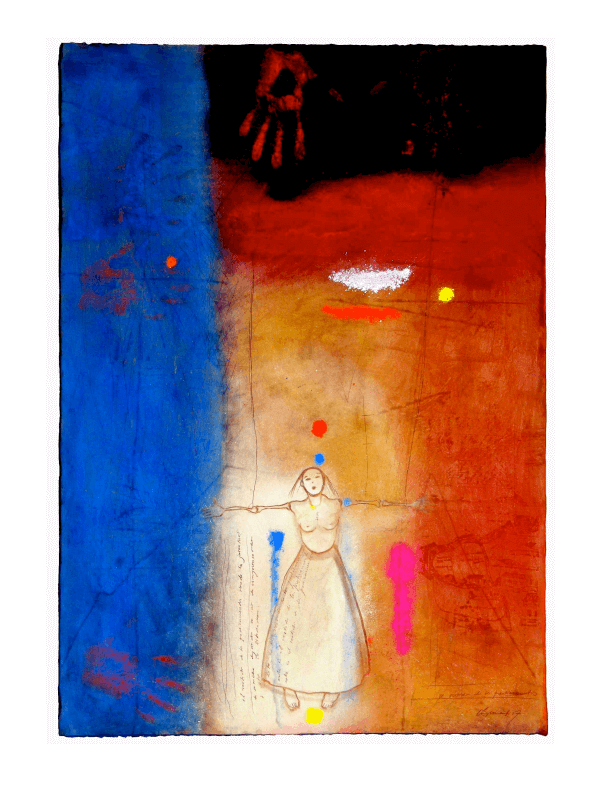
6. Claudia’s Artist Statement
In a fresco, the pigments are not painted on the wall they are embedded in plaster in such a way that the pigments become the wall. In my work, I depart from the same principle: the pigments become the paper. I use pure pigments that are embedded in the paper by the pressure of a printing press. No binder, oil or medium is used in this process allowing the pigments to maintain their purest intensity. Each fresco on paper is the result of multiple runs through a printing press where layers of pure powdered pigments are pressed into wet paper. The coloration, often times, is a process of subtraction, a scraping away from the layers, a patient uncovering of colors reacting among themselves alchemically.
For the last fifteen years I have collaborated with the Argentine Forensic Anthropology Team (AFTA) in investigations of violations of Human Rights. The task of this group is to perform exhumations of mass graves in order to determine crimes performed against civilian population. I participated in exhumations in El Salvador, Guatemala, Argentina and Ethiopia. My artwork is profoundly influenced by these experiences. Not only in the narrative aspect of the piece but, most importantly, in the conceptual realm of finding images through the searching of layers of colored dust. I scratch the surface of the piece identifying human figures that interact with the world of the hidden images. The pigments convey the essential "materia prima". The intensity and the fugitive condition of pigments, so fragile yet persistent, are metaphors of the elusiveness of life and the never-ending determination of hope.
The installations are frequently created upon testimonies recovered during the exhumations. I conceptualize each installation as a documentary, departing from the reports presented by AFTA to the Supreme Court of the country where the investigation takes place. The reports narrate, chronologically, the findings of human remains and associated objects constructing a historical account of the massacre. The creation of artefacts and associated objects resembling the actual findings convey my visual response to the violence that I had witnessed. My intention goes beyond political criticism. It is a way of retaining the communal memories of the survivors.
7. Sample Bios
Kate Breakey Bio
Kate Breakey has gained international recognition for her large-scale richly hand-colored photographs. Since 1980, her work has appeared in more than 56 one-person exhibitions and in over 50 group exhibitions in the United States, Australia, New Zealand and France. A native of South Australia, Kate moved to Austin, Texas in 1988. She completed a Master of Fine Art Degree at the University of Texas in 1991 where she also taught Photography in the Department of Art and Art History until 1998. In 1999 she relocated to Tucson, Arizona. Breakey’s work is held in many public collections, including the Australian National Gallery in Canberra, the Center for Creative Photography in Tucson, Museum of Photographic Arts in San Diego, and in Texas, Austin Museum of Art, the Museum of Fine Arts in Houston, and Witliff Gallery of Southwestern; Mexican Photography who have collected over 150 works by Breakey since 1999. In 2004 she received the “Photographer of the Year” Award from the Houston Center for Photography.
In 2001, the first monograph on Breakey’s work was published by the University of Texas Press. It contains 81 color images from her ongoing “Small Deaths” series, with a forward by noted art critic A.D. Coleman. Her second book, Flowers/Birds, (Eastland Books) was published in March 2003.
Crista Cloutier Bio (old)
Crista Cloutier is the director of Segura Publishing Company, a fine art publishing studio located in Tempe, AZ. There, she collaborates with significant contemporary artists using print processes that further the creative possibilities for photographers and conceptual artists. Cloutier is also a producer with Encanto Films, creator of the awardwinning documentary Pasa un Angel: the Art of Claudia Bernardi. Ms. Cloutier received her undergraduate degrees in Photographic Studies and Art History, with her Master's Degree in Religious Studies from Arizona State University. She is recognized for her work in the intersection of art, politics and religion. Currently, she is writing the biography of 19th century spirit- photographer William Mumler.
Jill Bell Bio (fictional example)
Born in Detroit Lakes, Minnesota in 1963, Jill Bell is an emerging painter and quilt-maker whose work captures the fluidity of the mysterious realms of the human condition. Bell’s fascination with art began as a small child, and she drew for many years before setting her brushes aside to focus on raising her family. Though she wasn’t actively making work during those years, she photographed continuously, developing her eye for detail and nuance. Largely selftaught, Bell has taken several painting workshops where she has studied with celebrated artists including Emily Dahl and Richard Flood.
Bell’s work is included in several local collections and has shown on the walls of Starbucks, introducing her work to a wider audience. She won “Honorable Mention” for her painting “Skylark In Her Hands” from the Detroit Lakes Town Art Contest. She is a member of the Detroit Lakes Painting Society.
Currently, Ms. Bell is working on a private commission and preparing a body of work for future exhibition.
Which speaks to you the most? What elements can you borrow that will suit your own story. What do you think each artist left out to make their bios so succinct?
8. Write your own bio.
A bio is a one or two paragraph summary of your accomplishments written as a narrative in the 3rd person. It hits the highlights of your cv.
You may include where you were born, where and what you studied, who you studied with if pertinent. Include any interests that might pertain to your work - such as the environment or kittens. Any scintillating facts about you and your work or methods should be included. Feel free to reference your background, influences, or working technique.
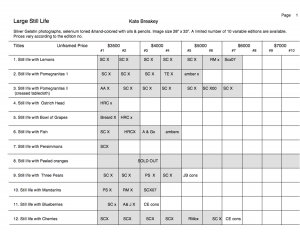
9. Kate Breakey Price Sheet